Search Mocavore

Showing posts with label cooking. Show all posts

Saturday, July 13, 2013

Homegrown Lion's Mane


This Spring, I got a Lion's Mane mushroom kit at the farmer's market. It's a bag about the size of a fat gallon of milk, loaded with sawdust impregnated with mycelia. Having failed before, I tried a new set-up, consisting of a 5-gallon bucket with a rock in the bottom for the shroom-bag to sit on, just above an inch or two of water. Sitting on top of it all was my broad-brimmed field hat, holding in the humidity.

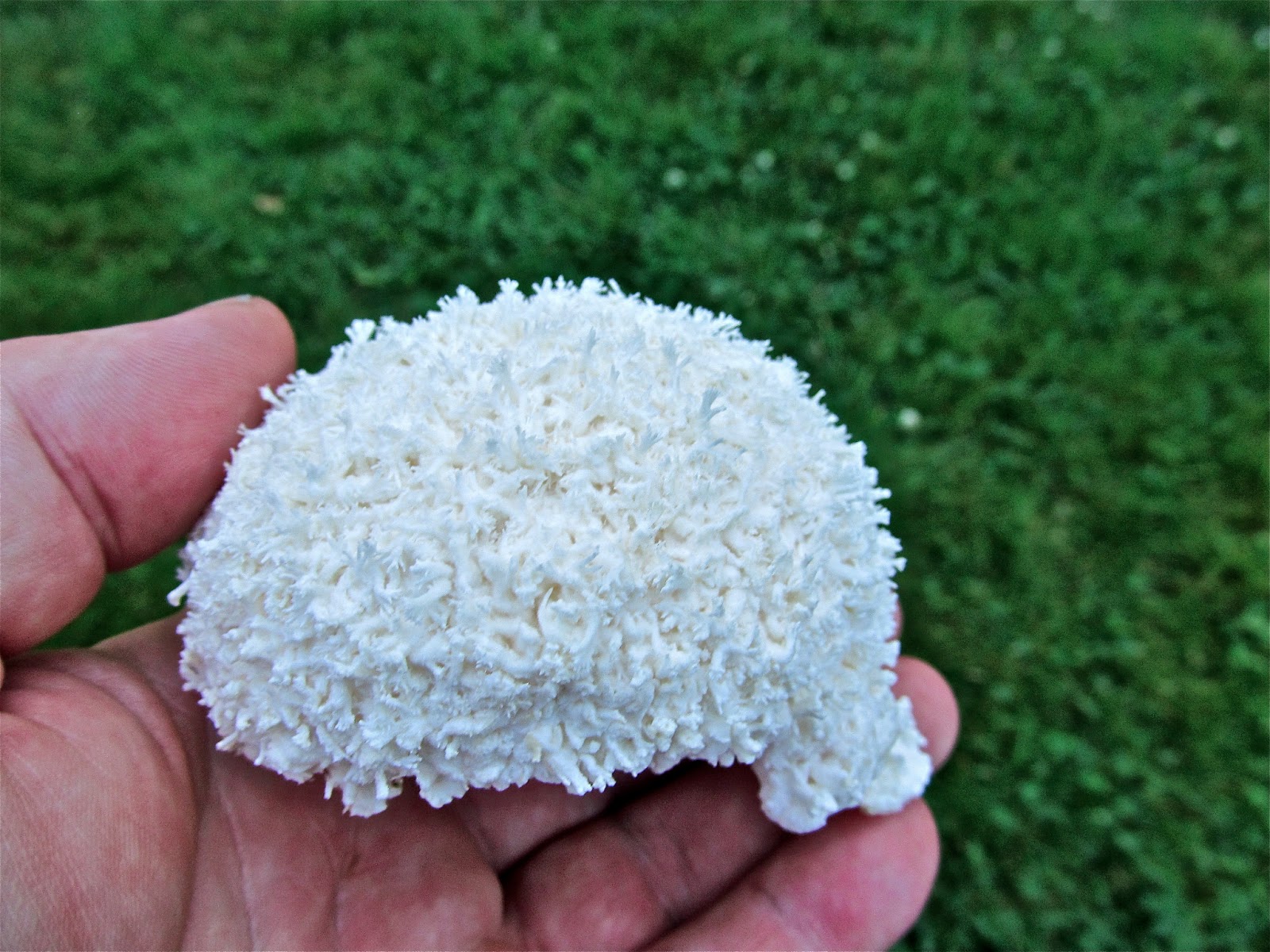
All you have to do is poke a few holes in the bag and set it in a humid place (well, you also need a certain amount of free airspace around the bag, and not too much water, heat, cold, light, or spores of more aggressive fungi, slimes, molds, and bacteria). When they reach baseball size, the instructions say, it's time to harvest. But I let one go to see what would happen, which turned out to be pretty interesting.


It goes fractal. More like sea-life than a lion's mane. There's still a core (the cut 'stem' at the center of this photo), but branches proliferate, more and thinner with each iteration.

After cutting them loose, I did what I do with most fung-food: sauteed with butter and garlic (or onion, shallots,...all alliums). Next time around, I'll try some other preparations. Those tendrils in broth would work like egg-drops in soup, weaving well with sprouts and delicate vegetables.

The center, or the whole mushroom if you follow instructions and pick it small, is meaty. To me, there was a chewiness beyond what portobello achieves, and I'd like to try using these for burgers. Slices in the sautee ended up more or less like meat. I'd use this in stir-fry in place of chicken--the texture was better than tofu or other mushrooms in that respect.

Monday, June 3, 2013

Morels Now and Later

Fruit o the Morel

The "naturals" come before the wild-fire borne morels, so says the picker, and I have no reason to doubt them his expertise, although I did walk away shaking my head as he continued to rant about Obama and what "they say" are his impeachable offenses.

The guy's politics are not enough to make me pass on the fresh mushrooms in a bin propped up under the shade of his pickup canopy. (If it were a Dodge, I'd pass, but it's a Ford, so OK.) Also, his price is 33% below that in the stores and farmers market, and they're clean, firm, not too old or bug-eaten at all.

Shallot Scapes

Not irrelevant to this decision is the fact that I felt the need to go harvest shallot scapes and make use of them before they got too big and tough. And so it was that a few hours later, an age-old skillet that got my dad through grad school many long years ago got a taste of allium-mushroom-butter. Attacked by a bout of forethought, I decided to slice up the bigger (less likely to quickly dry) morels first. Here is what that kind of fresh looks like:


But the kind of deal I got feels too good to fritter away on a few ounces of fungal goodness, and I purchased a pound. Which in turn is too much to fritter away on a meal eaten alone. With all the big scapes cut, I could've tossed the shrooms in a paper bag in the fridge and reapeated this gistatory goodness in a few days, but the cheapskate in me has touble eating that high on the hog twice in a week. So the tuna can came out of the cupboard and the remaining morels went into the oven to dry out.


You may have guessed by now that I am not the kind of guy to have a food dehydrator, and the day in question was cloudy with intermittent rain, so sun-drying was not an option. So into the wee convection oven they went. Various web pages dedicated to mushroom-drying advise against exceeding 175 degrees fahrenheit, lest the psychoactive chemicals degrade, and even thought I am in a different genus, interested only in food, I figured 150 was good. The fan keeps the air circulating, and a fork propped in the door lets moisture escape. This particular oven shuts off after 30 minutes, and I just kept rpeating the process until the mushrooms were hard little nuggets, like this:


Drying morels this way realeases and maybe bakes the spores, causing this nice pattern to appear on the pan. The cooled morels went into a mason jar for later use. They smelled intense, no hint of burn, and it seems like my ad hoc dryer worked just fine.

Monday, May 21, 2012

Rhubarb Poppyseed Bread


I'm headed toward bringing in the next batch of rhubarb, which reminds me that it's been a few weeks since the bake sale, when I MoGyvered up that rhubarb recipe. Maybe you just searched for "poppy seed rhubarb," and found yourself here, faced with this monstrosity. Scroll down if it's just the recipe you want, otherwise I return you not to a digression already in progress:

What the hell is that thing in the picture? Face like a pugnacious ninja kitty, or a morbidly obese viper,...whatever the case, it's got hair like Moe Stooge. 

But it's delicious. The photo is of the runt of the batter, the leftovers baked in the tiniest corningware. The better ones looked like this:

What? Another cartoony bake-face?


The challenge of baking in bulk led me to this recipe. I'd been planning on lemon poppy bars, but health regs (yes, there are rules for even bake sales, so we don't all die horrible deaths, poisoned by amateurs) don't like custardy stuff and demand a level of packaging that would be inconvenient or wasteful for something so delicate.

A quick bread would solve this dilemma, or maybe a lemon poundcake. But as it turned out, there weren't all that many lemons left in the house. But there was a ton of rhubarb ready to pull, and those red stems are tart, so lemon poppy bars became rhubarb poppy bread. Poppies? Yeah. I grew breadseed poppies last year, and had about 4 cups of seed. I'd been seeing a cars with small hubcaps parking nearby, two guys in dark glasses sitting in it pretending to read newspapers, and I knew it was only a matter of time before the dragnet closed around me and the raw uncut kugelach with a street value of dozens of dollars, maybe.

Not kugelach, actually, but another type of European poppy treat bastardized by an American. Something like Mohnkuchen, to use the Deutsch, a bread topped with a mixture of farina, poppyseed, sugar and vanilla. The bread I treated like I did banana bread when I grew them in Hawai'i: put way more fruit than any recipe calls for, and get something as close to bread pudding as to bread, dense instead of crumbly. So I substituted a bunch of rhubarb (cooked down to applesauce consistency) for the eggs and some of the milk, and put just enough sugar to take the edge off. The bread lacked the tart zing I'd been going for,  but it worked out fine.

And here it is:

Mohnkuchen(isch)
First, mix up the bread, which requires:   
  • Flour         3 cups
  • Sugar        2/3 cups
  • Baking powder      1 1/4 tsp   
  • Baking soda    1/3 tsp
  • Salt         1/2 tsp
Mix all this in a big bowl, and then stir in:
  • Rhubarb sauce    1 1/2 cups
  • Milk       3/4 cup
Go ahead an plop it into a big greased loaf pan, and get going with the topping, which means you have to make cream of wheat with poppyseed in it (or, vice versa). So bring 2 cups of milk to a near boil and stir in:
  • Poppyseed     1 cup
  • Farina        1/3 cup
  • Sugar         1/2 cup
  • Vanilla       1 1/3 tsp
  • Butter       1 Tbs
This will thicken up quickly, and you need to make sure that you keep stirring so it does not get too lumpy. But there will be lumps. It is the essence of farina. Be at peace with it, and think about the egg. Because you need an egg. But if you dump it into this mix it will cook immediately, and what you want is to blend it evenly. 

So get a spoonful of the poppy farina and sit it on the counter. Now crack the egg in a bowl, beat it, and if the spoon has cooled off, stir it in. Keep adding small amounts of the poppy mix until you have a cup or two of the stuff, which you can now stir back into the main pot o poppy mix. 

Then pour this on top of the bread batter in the pans. I found that a slit down the middle of the bread batter seems to keep the poppy on top, unlike in the experimental first batch pictured in cross section above. 

Slide your fake mohnkucken into a 360 degree oven. I cooked for a while, but don't recall exactly how long, and I was doing a half dozen loaves at once, so it won't be the same for you anyway. A nice mahogany color on top seems to be about the stage where you should get it the heck out of the oven.

Tuesday, May 8, 2012

Tails


The Salish Sea pulses with life, schools and shoals swarm forth each in their season. Americans have gotten used to suspending seasons, eating tomatoes year round, never fretting over dwindling root cellars, and forgetting for the most part about special treats summoned by a Spring rain or a Summer sun or a Fall run. 


A step removed from nature, we people have set what we call seasons when it is allowed to fish or hunt for most of the edible ones. Recently there was a season for Spot Shrimp (Pandalus platyceros, the largest species on the West Coast), and I happened to be a step removed from a fisherman who made a good haul. 


This was my first encounter with this bundle of marine protein, but a prawn is a prawn, and anything that you can prepare on the day it was caught will be at its novice-forgiving best. Better yet, Spots make it easier by not having that vein of poo running down the tail, needing to be laboriously cut out. The carapace stretching back from the eyes holds all the guts--you snap it off and get rid of it (skip over to the "Heads" post at Urban Greenstead for that and of this tale).

Easy. Done with 5 pounds in a few minutes. Tails in the fridge and ready to be dinner. 

This is where a food blog is supposed to have a beautiful picture of the prawns in prep, and another of plated sublimity. But I procrastinated, as usual, and when one of the shrimp-eaters bailed, and only one of my family likely to even try them, I found myself putting them in the freezer at 9 at night. So you get no photo spread, no great recipe, no companion dishes. The only thing of value this post really has to offer is that when you freeze these critters, cover them in water, or when they thaw, they'll be mushy. 

A few days later, I did get around to cooking up a batch, but again there is little to offer the reader. My sole method was to assume that melted butter full of garlic chives would fix any flaw.  I thought I'd steam them, but fat or something in the shrimp made the water boil a massive foam that forced me to lift post from burner and lid from pot. The daughter brave enough to try retreated before too long because the "feet-thingies creep me out." My shrimpficionado guest allowed that they were OK, but not spectacular. I felt about the same; the garlicky butter made it ok, but couldn't quite overcome the taint of failure to eat some that first day, or completely hide the mushiness I thought I sensed. 


But, no disaster, and no waste. Errors and lapses are alright if we learn from them. There will be another shrimp season, and I'll be ready.


Thursday, May 3, 2012

Blurred, and finally Procrastinated

Ersatz Mohnkuchen-machen, ein dizzying untertaking. (Focus on the center of the stir, and the dizziness may subside.)


So there was this bake sale, bloggers raising money for the food bank. Collateral benefits may have helped drive up traffic for some of the fine bakers who contributed, but I slacked off and put off until I had nothing to put in the packages: no cards nor stickers proclaiming the name of my bog.


And it's best I didn't, because there are some talented and committed folks cooking and writing about food in our town, and probably in yours, too. Read them regularly, procrastinate here intermittently.


My blog sleeps for weeks, and upon awaking may croak only some snore-snort rant with nary a recipe nor useful fact at hand, only to slip back unto comatosis. But now that I am comfortably in the next month, I can blog about the bake sale. 

I'd spent the week prior in a desultory/manic oscillation, and a test run on the granola bars had me confident about that recipe, so what remained was how to handle my obsession with using up a bunch of poppyseeds I had, a few cups from the past year or two Hungarian Breadseed popping up. The county health department seemed especially leery of custardey type stuff, so the lemon bar things I'd been thinking of were out. 


But hey, I had a bunch of rhubarb, and that's tart, right? So I decided that a quick bread, using rhubarb sauce (and as it turned out, winesap applesauce as well) in place of eggs and some of the liquids. Plenty of it, too, to make it a dense moist bread, atop which would be the farina-poppy-vanilla concoction that you find in Mohnkuchen, Poppycake, a European treat. 


A test batch on Bakesale's Eve turned out pretty well, and after finishing 4.5 dozen granola bars (another post, maybe) I went to bed satisfied and ready for the next day, which I had wisely taken off to devote my full energies to baking, and drinking coffee...and surfing without writing...and gardening. And then it was 2 hours before the bake sale and not only were a couple of loaves of fake mohnkuchen not done (crowded oven, and did I mention that the batter is dense and wet?) and none of it was sliced and packaged. "Probably too late to conceive, design, and print labels now," I procrastinatorily realized, and set my elder daughter to work on getting baked goods in ziplock bags.


And it turned out fine. I got to meet some other people willing to bake for a good cause (the Thurston County Food Bank, to be specific), not to mention Arts Walkers happy to happen upon a big table full of cookies, confections, and treats for a dollar a piece. Lots of them donated more. Generosity flowed, and swimming in that stream feels good. Us blogger-bakers agreed that we'd crammed well over a dollar for ingredients alone into these $1 delectables, but what we spent helped maintain jobs for farmers and millers, and it was fun. About half of my stuff sold, and the rest was headed for hungry people. To top it all off, I had a really nice time with my elderkid, who reacted to me making her help out at the bake sale with a stellar performance. 

Agreeing to deliver 100 pieces of baked goods, fresh at a certain hour, to raise money for a fundamental feeder of fellow people, is more cooking responsibility than I'm used to. Creative indecision (which is what I sometimes call "procrastination") made it more off-kilter and last-minute frantic than it needed to be, and the day leading up to the sale looks from this vantage like a blur, but a comfortable '70s warm-toned buzz of a blur, with none of the careening vertigo you might sense from that first photo. But then again, not the static clarity of the second, either. Motion all day--arms stirring and whipping and folding, mind pulling body from pantry to stove to counter. Too much to account for without criminal dullness, blurring together into a single simple goal: get the stuff ready by 4:00.

And at 4:00 my truck parked illegally and me hoping that the traffic cops were themselves procrastinating, I was delivering rhubarb-poppy bread and locavore granola bars to the bakesale tent. At 7:00 I was back with daughter in tow, and we sold til 10:00. Missed Arts Walk myself, but enjoyed the night, the people, and of course the bag o goodies I purchased for us. Drove home and fell asleep, glad there was nothing to do the next day til late afternoon and the Procession of the Species parade...which is yet another post I'll get to....some day.


Sunday, January 15, 2012

Lord Marmelade

[What follows is a post originally from Mojourner Truth, but it's about marmelade time again in the Mocavore kitchen, so I am in a recycling mood.]

The title here is a twisting of Lady Marmalade, whose gichy gichy yaya is one of the few riffs guaranteed to get me dancing, but which has nothing to do with this entry. That weren't no lady, and marmalade seems so un-funky, more old-fashioned and British. Ergo the "Lord." 


Paddington Bear and old women take their tea with marmalade at the ready, it's medicinal power soothing the harm done to one's palate by the clinkery toast favoured on that side of the pond. My grandparents liked it, and I do too, but few devotees are young. Not sweet enough, too full of the peel that Americans have cast off for generations.

This concoction's etymology trails back to classical times, alluding to the Greek "honey apple," an apple grafted to the quince. For a long time, it has meant a jam or preserve including citrus, the acidity probably important before sanitary canning, preservatives, and pasteurization. 

Now it's a nostalgic taste to some, to me. I made some batches this year, both to practice the science of canning which was nearly lost by my generation, as well as to savor something grandma made. The first time I used blood oranges, which I'm guessing would have been unimaginably exotic in central Ohio during the Depression, when as a young mother she began canning in earnest. I followed her lead, and made a portion into "hot jam" by inserting a cinnamon stick into each jar as it was filled. I also experimented with some, adding some local cranberries to the mix to redden it further and add a bit of bite.

Equally exotic may have been the preternaturally orange navels of the modern supermarket, bred for looks, tasting like water. The blood oranges had the allure of aroma, more flavor packed into a tennis ball sized fruit than in the softballs lobbed out of Florida by the trainload. Even better, they were on sale.


Same goes for the variety in the next batch. The local grocery had a sale on "Cara Cara" oranges, which were dead ripe and redolent of heaven as I walked in. I immediately filled a couple of bags with the fruit, same size as the bloods, similarly ugly on the outside with patches of green, some blemishes, and even a soft spot or two (all of which told me the "organic" label was not fake, and that they'd been picked ripe). This time, I went for straight marmalade, no experimental or family-inspired additives.

I don't have grandma's recipe, and had to go looking on the internet, my approach to which is to triangulate, to look at plenty and attempt to discern a logic. The first task is always to weed out the bullshit: the people repeating some untested recipe because they like to post stuff, the "easy" versions maximizing prepared stuffs and minimizing cooking, and the just plain mistaken. Eventually, I zero in on the essentials, and get an idea of the leeway in ingredients and proportions that won't result in failure. The rest is reconciling units (cups versus pounds of sugar, pounds versus numbers of oranges), and trying to figure out what my palate wants compared to typicality, which in this case was less sugar.

In the end, it was this:
  • 10 pounds of oranges (32 or so of the size  favor) - Peel the zest off of about 1/4 of them, quarter and thinly slice everything else.
  • 6 cups of water - Add this and the oranges to a large steel or enamel pot, and gradually bring to a boil. Keep cooking til the only identifiable pieces are the rinds, which should be quite soft.
  • Now, turn it off and do something else til tomorrow. You may want to cover it to keep the varmints out
  • Start again by gradually returning your orange slurry to a boil. 
  • 10 cups of sugar (You have pretty wide latitude here, I think. Add less to begin, and keep adding til it seems right to you.) - Add the zest and stir. And stir! If you don't it'll start to stick and burn on the bottom of the pot. 
  • The mixture is sneaky and vindictive at this point--it will look calm, lulling you into not stirring. Then when you start again you release a sudden violent boiling, a volcanic eruption of orange lava hotter than boiling that will stick to your skin and burn like hell. Sweet hell, but painful nonetheless.
  • A lot of recipes carry on about how you need to bring the stuff to 220 or 222 degrees, or the jam won't set. I've never managed to get it past about 215, and it has set fine. The key things seem to be: it gets darker, you begin to have trouble keeping it from sticking and burning, and it gets thick enough that after a while you cannot stand to stir any more. It's done, so you can it.

This last batch went into some old squat jars I got at a yard sale. Some proudly proclaimed their modernity with embossed patent dates from over a century ago (the same wide-mouth lids of today work just fine, and it's good to know that some things don't change). 

I dipped into one of these pots of marmalade--talking in a Paddington accent of course--and was rewarded with the colour and flavour of liquid sunshine. Nostalgic in name and appearance, perhaps, but as bright and fresh a taste as I could imagine. 

Yum.

Sunday, November 20, 2011

Recipes? We don't Need Recipes! (Usually)

"Badges? We don't need no stinking badges!" is not only the most famous (mis)quote from Blazing Saddles, it is a guiding principle for many of us, and this holds true in the realm of food, from its growing (I'll never be a certified Master Gardener) to it's consumption (I enjoy what I like with a blissful ignorance that appalls true foodies). So it should come as no surprise that my cooking is only loosely guided by recipes. I am no baker or devotee of Spanish molecular cuisine, so it usually doesn't much matter. 


Last year, Mom gave be a little booklet of photocopies of recipes written in her hand and those of my grandmothers and some other relatives. I've referred to it once or twice with re-creation of a family favorite in mind, but mostly it is a talisman, a link to childhood and my ancestors. Mom herself had a wooden box full of index cards, clippings, and various scraps of paper with instructions for construction of all sorts of concoctions, some of which she actually made, and others of which were more aspirational in nature. When the computer age dawned (maybe 'mid-morninged' would be more accurate), she saw the devices as an exciting new form of wooden box, and began a process of entering recipes that continues to this day.

I'll cop to following a few recipes. When canning, for instance, I'm still too new to be automatic and I have a healthy wariness of botulism, so I follow the guidance of people who know better. And for some reason, I still look up the proportion of water to oats every time I make oatmeal. 

But what about when making something new? On occasions when I'm trying to replicate something particular, I'll use a recipe. But it's usually a matter of looking up a bunch of them, discerning the commonalities, and distilling an essence that suits me. Then, adding back on ingredients geared to my own taste, maybe changing a technique to something I'm more likely to pull off without burning myself or the meal. I triangulate, augment, omit, and alter at will. Then, often as not, enough time passes that I have to do the whole process over because I didn't write anything down (so I'm not claiming to be too smart for recipes...just cantankerous).


Some people have trouble operating this way, because they feel like the person who wrote the recipe knows better. Seems mutton-headed to me, since most recipes now come from free-lance writers and amateurs whose main qualification is that they can post to the internet. The same people who bring you fluff and porn, neither of which is all that satisfying, and one of which leads to a funky aftertaste. Sometimes, they're flat out wrong about something, and if you follow their directions, you end up with your meal tasting like someone recipeed on it.


Taste matters, if only to yourself and the people at your table, so that's where I leave the recipe track fairly often. I like grinding pepper into just about everything, whether the recipeer thought of it or not, and go heavy on the garlic. An epidemic flaw affecting many recipes is the under-use of a signature ingredient: one banana banana bread (try as many as you can fit in the pan), a fractional teaspoon of anything. I sure as hell remedy that. Oh, and if it calls for something I don't like, it ain't going in.


Practicality trumps fidelity. I substitute all the time. Like, my cupboard may or may not contain shortening (honestly, I don't know or care) because I use whatever else works, and it only sees use when a grandma appears and wants to make pie crust. Speaking of which, I skip the crust often as not. Gimme the inside, where all the good stuff is. I do not now and never have had saffron (queen of under-used signatures) or a host of other ingredients that are expensive or only good for one dish. Food on hand must sometimes transmogrify: yogurt to cream, pumpkin to sweet potato, nettles to spinach. And as far as cooking method, if it cannot happen with the utensils and cookware I have, then it ain't happening, or it's going to be McGyvered. 

One thing I've never been able to understand about recipes is that they seem to have no sense of reality when it comes to quantity. "Yields a dozen" rarely proves true, unless you are one of those people who likes tiny food, and especially when a recipeer wants to be healthy or lo-cal, they tend to create portions that bear no resemblance to reality in the U S of A.  Another quantitative delusion is that the Recipe is so paramount that cooks should do things like use half a can of something, or a fractional fruit. No, you base your pie on the pumpkin you have, and if there's more than enough filling, you dump the rest in a casserole dish for some creamy crustless extra. Having unused food fragments at the end usually leads to waste, and basing your dish on units such as the amount of tomatoes you picked one day or a 24-ounce can makes life easier.


Quantities expressed not in tablespoons or ounces (or the dullest of all, grams), but in friendly fuzzy terms appeal to me, partly just because they sound cool: shake, smattering, smidgeon, sprinkling,...and that's just the S's. I guess people have tried to quantify dollops and dashes, but I'd rather retain the mystery. Units like these leave room for individuality, they respect autonomy. Handfuls and pinches remind us that the basic scale of cooking is human. 

The variability and vagueness to these also says something about how we've passed on culinary culture over thousands of generations. I've asked old women about how much of an ingredient to put in, and plenty of times gotten answers like "Enough," or "It depends..." They're saying that you cannot reduce a good dish to a list, they're testing to see if you really want to do it right, they're wondering whether you are worthy of receiving their knowledge. Or they're just foggy, maybe cantankerous, or just having fun messing with you. But they have ancient knowledge sometimes, and it's better to learn their way with all its seeming imprecision and archaic measurements. You'll end up with something deeply tasty. 


The tasty things I manage to serve up eventually repeat themselves enough that I suppose I settle in on a recipe, at least in my head. In the past year, as I can and make jam more, I've taken to writing down what I did. Sometimes, anyway. At some point, I may park some of those on this blog, more so I can find them again then to encourage any of you to try them. You may, and it's possible that you'll even like it, in which case I encourage you to write it on a card, put it in a box, and pretend you made it up. But really, you don't need my stinking recipes.