Search Mocavore

Tuesday, April 22, 2014

Vinegar Vinter


Winter began with me leaching sugar from apples I'd already squeezed the cider from. Then, my juice-aholic neighbor gave me a bunch of de-juiced pulp. Mostly carrot and apple, I think.

Luckily for me, there was plenty of veggie-fruit sugar, and I dumped it in a bin with some artesian well water, snapped on the lid, and walked away for a while. When fermentation slowed down, I strained everything through cheesecloth, put the liquid in the big jar (above), stashed it in a cupboard I rarely open, and walked away for a while.


This is the bacterial mat that made the vinegar. The small light patches are the newborn colonies of mold, I think. The vinegar is ready, and it's time to pull off the mother floccor, strain, and bottle the product before the mold messes it up.


I like the result. Smells as bright as it looks. At about 3.3 pH, it's plenty tangy, and tastes good. I think this one may get really good with aging.

So, it looks like I can continue to wring another product from leftovers of juicing and cider-making. Someone asked where I got the "mother" (the colony of flocculants some people call a SCOBY, used like a sourdough starter to get the ball rolling), but so far I haven't used one. I decided to try an approach that is lazy (or smart), cheap (or frugal), and unambitious (or stoic, maybe zen), and walked away for a while. Unlike beer, where a wild ferment will not yield what beer drinkers want, vinegar makes itself with the microbes ranging free in the Eastside Olympia air.

Wednesday, January 8, 2014

Crapplesauce (better than it sounds)

You can tell this is not stock imagery or a fine foodie foto, because there's some dried up crap on the stove.

Despite my best intentions, I sometimes end up with produce that did its producing months ago. This time around, it was cranberries I got at the Farmers' Market before Thanksgiving, and apples that my master bartering (again, not as bad it sounds) neighbor had decided were too old and dried out for juicing weeks ago when he gave them to me.

Procrastination and a healthy scientific interest in fruit mummification wanted me to just let it be, but frugality and fear of waste animated me, and I decided to combine apples and cranberries. OK, I admit, the cranberries entered the equation when my commitment to drying them waned. Dehydration by way of repeated low-heat oven exposures (while it may work out as the cheap man's way of heating the house), takes too damned long in a Pacific NW Winter.

So, core and chop apples, and toss them in with the cranberries into a pot on the stove. Add a little water, and avoid the temptation to get it done with fast. Simmer...add some water...simmerrrr...add a little more waterrrr. Listen to Hendrix (the dude grew up in Washington, so he must've eaten a lot of apples, right?)...stir. Maybe add some more water (yep, them apples was pretty dry).


After a while, the album (Are You Experienced) was over, and the apples still had not broken down, so I brought out maybe my most favorite electric kitchenland appliance ever: the immersion blender. And so red-smeared chunks of apple (complete with their old leathery skin) became the paste you see pictured above. It's amore interesting color than you can see on your screen. The flavor is slightly tart, and I added no sugar, so that in addition to being frugal, I could count myself smug over the healthfulness of this concoction.

I the tradition of the Mocavore Blog, I now offer to the gullible world a recipe for something that does not need a recipe:


Recipe for Crapplesauce (I should find a better name)

Ingredients
Apples - however many you feel like coring and cutting up
Cranberries - enough to turn the apples red
Water - small additions to keep from burning the fruit

Preparation
Combine all of the above and simmer until tinder, adding more water as needed and stirring occasionally. When the apples can be cut easily with your spoon, and you are bored with stirring, blend the cooked fruit until it qualifies as "applesauce," rather than "chunks covered in red."

Friday, December 27, 2013

Cobbled-together Kimchi

Farmers Market Napa and Home-grown Daikon Greens

Late in the Fall, I finally got around to a couple of things. One was admitting that the daikon I planted was never going to make roots. Most of the summer planting bolted almost immediately, and the few plants that didn't never managed more than cracked, deformed, and undersized chunks underground. The second thing was realizing that I had a head and a half of napa cabbage yet un-used in the fridge.

So, kimchi.

There are plenty of recipes online, a suprising number of which make no sense. Some, because they are in Korean, which I do not read. Others, because they are in American, and are fake or wrong.

So I searched some more, and dredged up old emailed advice from a Korean friend of an Irish friend. This boiled down to: sweet rice flour is a good aid to fermentation, and you should use the greens you have.

Rinsing away the salt
So I stripped the greens off the straggling remnant of my failed daikon crop, a couple of stray mustard plants, and cut up the napa cabbage, then tossed it with kosher salt. Pressed out the liquid and rinsed repeatedly to get rid of (most of) the salt.

And so it begins.
Then I chopped in a mix of home-grown garlic and chilis (cayenne-ish, although NW peppers never seem to get as hot, and these were old), some store-bought dried ancho chilis (with their tobacco-raisin dimensions), and...maybe that's it. Except for the rice flour porridge, which I'm guessing is food to kick-start the microbes. Mexican anchos, Japanese rice flour, and bastard mustard may not be authentically Korean (also, I guess people used to fermenting in an onggi might look askance at my salvaged crock-pot), but somehow I imagined that using what was handy and seasonal would be acceptable to a fair proportion of Korean grandmothers, so I went with it.

The non-photogenic end result.

And before too long, I had the above. Not tongue-blisteringly hot, and oddly smoky due to the anchos, but tangy and tasty. These greens will not go bad, or be wasted. It's not bad, and that is good. It's probably even good for me. Hope so, because I've got a half gallon of the stuff. 

Sunday, December 1, 2013

Vinegar Time

Mother-floccor

Now that Stoic Week is done (in the time zones where it applied, anyway), a procrastinator like me can get around to writing about taking the world as it is. Putting things off makes sense, a lot of times. Like: I've put off writing blogs lately, getting things done, having more time with my family, playing in the real world, and dealing with the bounty of Fall.

Not that the more chore-like of these accomplishments haven't got some delay built in. I should have dealt with the garden a month ago, for instance. And the subject of today's post--vinegar--evokes among many Americans all things sour and past due. There's a Cracker song about a downer of a person, who sees "Roses and wine" as "Thorns and vinegar." I've been accused of being that person, not always without reason.

Wine, cider, and any number of fruits, however, aspire to vinegaration. Humans arrest this development for their own tipsy ends (myself included), but there's no sin in letting the process keep going a bit further (especially with headache-inducing red wine). The Acetobacter microbes feast on alcohol, and piss vinegar. And if you are stoic, seeing that this cycle wants to happen, you can embrace the waste, wringing from it something sweet...figuratively if not chemically.

If I had the extra cider, I would have let some turn to vinegar. But I am a stoic who has also been accused of being cheap (Must I utter it? Not always without reason), and so my eyes turned to the pomace, the "spent" wheel of packed pomes pushed from the press. This year instead of turning it upon yon worm-heap, I dumped pomace into bins, poured in a bunch of Olympia water, and let them steep. Sure enough, bubbling ensued, signalling the emergence of alcohol from the old time + sugar equation.

After the action subsided, I strained out the fruit, and let the liquid keep doing its thing. The result was a jug of apple water, and a tub of pear syrup. I didn't stir either as much as you're supposed to, but after a couple or more monrths of inattention, I got to them in the slack time after Turkey Day and before returning to work. The results are a gallon of clear-ish sharp apple cider vinegar and 3-4 gallons of amber pear product.

The pear vinegar, coming in such quantity, led me to step in and halt to process for part of the batch. I pasteurized a bunch and bottled it in re-used and sterilized beer bottles. The rest is in half-gallon growlers in the fridge and garage. So if anyone wants a trade, let me know via the comments section or an email. I'll be hanging on to a fair amount, though, since my goal next summer is to make pickles with my own vinegar.

So yeah, sometimes I put things off, and sometimes I am sour. But one thing spoils and a new one emerges. Recognizing that the process will do what comes naturally and suspending belief that there is a hard and fast expiration date, allows time to keep flowing, to make December as fruitful as Summer.


Wednesday, October 16, 2013

Salt-Dried Garlic Update


In the beginning.

Back in January, as knobs sensed the lenghtening post-solstice days, I got around to preserving garlic for the rest of the year. As much as I love cutting into a fresh clove, there's no way I know of to extend that in the period from Winter til Summer Solstice, when the fresh snap softens and the white cloves develop a green core bent on autophagy.

As usual, I peeled a sizable portion of the crop and dropped it into olive oil. Over the years, I've occasionally read that this method carries a risk of botulism, but it's never happened to me--beware if you intend to eat some home-cooked garlic-rich meals cooked in my kitchen--and my main objection is that there's a bit of sulfur phunk to this technique.

This time, though, I took some of the peeled cloves and nestled them in layers of kosher salt. Seemed like it could work, but not knowing, it was a gamble.

At the end.

Just this week, after 9 or 10 months in the jar, I peeked at the result. The garlic dried to a pliable leathery texture without making the salt gooey or brown. Bite into it, and it's clear that some of its own bite has fled, but the result is a mellow richness, more of a complex flavor. Like replacing raw jalapeno with dried ancho, maybe. Sliced and cooked into a meal, it tasted like,...garlic. I have yet to taste the salt, but I have to think it will be pretty damn good.

So as experiments go, I'm happy how this one turned out.
Does it preserve my home-grown garlic? Yep.
Is it easy? Uh-huh.
Did the garlic sprout? Nope.
Is there a side benefit? Salt.


Wednesday, August 14, 2013

Land Tobiko - Poppy Roe


It's a little late to tell you now, but you can haz pappy roe. Like many esocteric gustatory treats, this treat is only available for a few weeks in any one place. This photo is a month or more old, and shows immature poppy seeds spilt 'pon yon plate. The green seed pod of the breadseed poppy (Papaver icannotrememberensis), can be split asunder to yield these seeds. In sushi or salad, or on top of a hotdog for that matter, the unripe seeds lend snap with a bitter crackle with a flowery aftertaste.

Leave 'em out, and they will begin to yellow and harden, and then it's too late.


The only way to eat these (other than blind-stupid early harvest) is to willingly sacrifice the promise of bagel or pastry with the black-seeded crunch of poppies. The pod cut open to free this caviar will not mature, cannot recover. Scoop out all the seeds and add them to whatever it is you have going that needs a light plantiferous crunch. There will be thousands, but not many.

You cannot buy this, and must grown it. A cold February casting seed. April thinning the progeny. June watching for the big-but-not-mature heads to offer up the bounty. Harvest only what you will eat within the hour. No prep time, but no shelf life either.

The unique snap of exocarp full of liquid so small in volume that it only regesisters as the snap against the skin. Like flying fish eggs - tobiko - this plantiferous roe gives the raw dish a crunch unlike almost anything else.


Saturday, July 27, 2013

Ozettes! (and Other Potatoes)


This has been a good garden year here so far, and mid-July brought with it a good harvest of potatoes. But I have a garden blog somewhere else, and it's the food that interests me here. Especially since this year was my first attempt at growing the Ozette potato.


Ozettes are what people call a 'fingerling' potato, mostly smaller than what you see here. This one has side sprouts, and looks as much like a Jerusalem artichoke as a potato. But that's the beauty of potatoes--a beauty hid from me for decades, growing up on nothing but Idaho Russets--that they come in so many shapes, sizes, and colors.

This variety gets's it's name from a place called Ozette, which also happens to be an archaeological site of huge significance. It's a site because Makah people lived there, and they've been growing these potatoes for centuries. Unfortunately, I don't have their origin story, but it's likely that Makah territory was one of the early landing points for the great Peruvian Potato Migration that spread tubers across the globe once Spanish ships started plying Pacific waters. But if the potato has not been here as long as the tribe, since time immemorial, it's been adopted by them for long enough to be a part of the culture now.

So yeah, it's a good variety for an archaeologist to grow, and it did well down here in the South Puget soils. And now that I have about 4 gallons of them, I'll get to try them in all sorts of ways. Ozettes, coated in olive oil and sprinkled with salt, roasted just short of crisp, chewy with a tough caramelized outer layer and a rich interior, mmmm. Simple can be best.

There's gold in them there hills.

The other varieties I grew this year were less interesting. Yukon Golds (above) were one of the first "other" potatoes available in regular American grocery stores of the late 20th Century, but to be honest the only reason I grew them was because I had some extra space and tubers that were sprouting. They're doing well, it seems like, but I haven't harvested them yet. When the time comes, they'll be the workhorse potato, boiled, mashed, roasted, whatever. Hopefully, they'll taste a little better for having been homegrown, but they're not exciting.

A basket of mascots.
The other kind of potato this year also came about as the result of profligate potato purchasing and the oversupply of aging tubers that follows for unambitious cooks like myself. This time, it was the only non-russet potato that I can remember way back into childhood: the Redskin. Yes, football fans, this is the way to use this word without being a racist asshole. I know, you don't want to walk away from your proud tradition (which has lasted, oh, not even 1/100th of the time Native people had their own traditions along the Potomac), and sports fans are not to be bullied by political correctness, but its mean and racist to keep calling your team that.

But yeah, redskin potatoes are fine. I'm looking forward to eating them. At least a few will go into sour cream and tarragon style potato salad. Tastes like summer.


And finally this year, there was a stealth russet, flourishing despite me. Potatoes actually came up unbidden last year from a previous renter's garden, but even though I hilled them up, they didn't produce. This year when it happened again, I ripped the shoots and thought no more. I did notice a survivor lurking among the raspberries, but didn't bother pulling it. Of course, I didn't bother helping it any, either, no weeding or hilling.

Then last week, because I wanted to clear some space for fall spinach, I did pull it out, and found about 7 pounds of potatoes hiding under the now luxuriant vine. I might not choose russets intentionally, but when a few meals worth drops in my lap, I'm grateful.

Now, all these potatoes (about 6 gallons and I have no idea how many pounds) are sitting in my archaeology screens in the garage, curing a bit before I stash them in the darkest coolest spot this hacienda has.

Saturday, July 13, 2013

Homegrown Lion's Mane


This Spring, I got a Lion's Mane mushroom kit at the farmer's market. It's a bag about the size of a fat gallon of milk, loaded with sawdust impregnated with mycelia. Having failed before, I tried a new set-up, consisting of a 5-gallon bucket with a rock in the bottom for the shroom-bag to sit on, just above an inch or two of water. Sitting on top of it all was my broad-brimmed field hat, holding in the humidity.

All you have to do is poke a few holes in the bag and set it in a humid place (well, you also need a certain amount of free airspace around the bag, and not too much water, heat, cold, light, or spores of more aggressive fungi, slimes, molds, and bacteria). When they reach baseball size, the instructions say, it's time to harvest. But I let one go to see what would happen, which turned out to be pretty interesting.


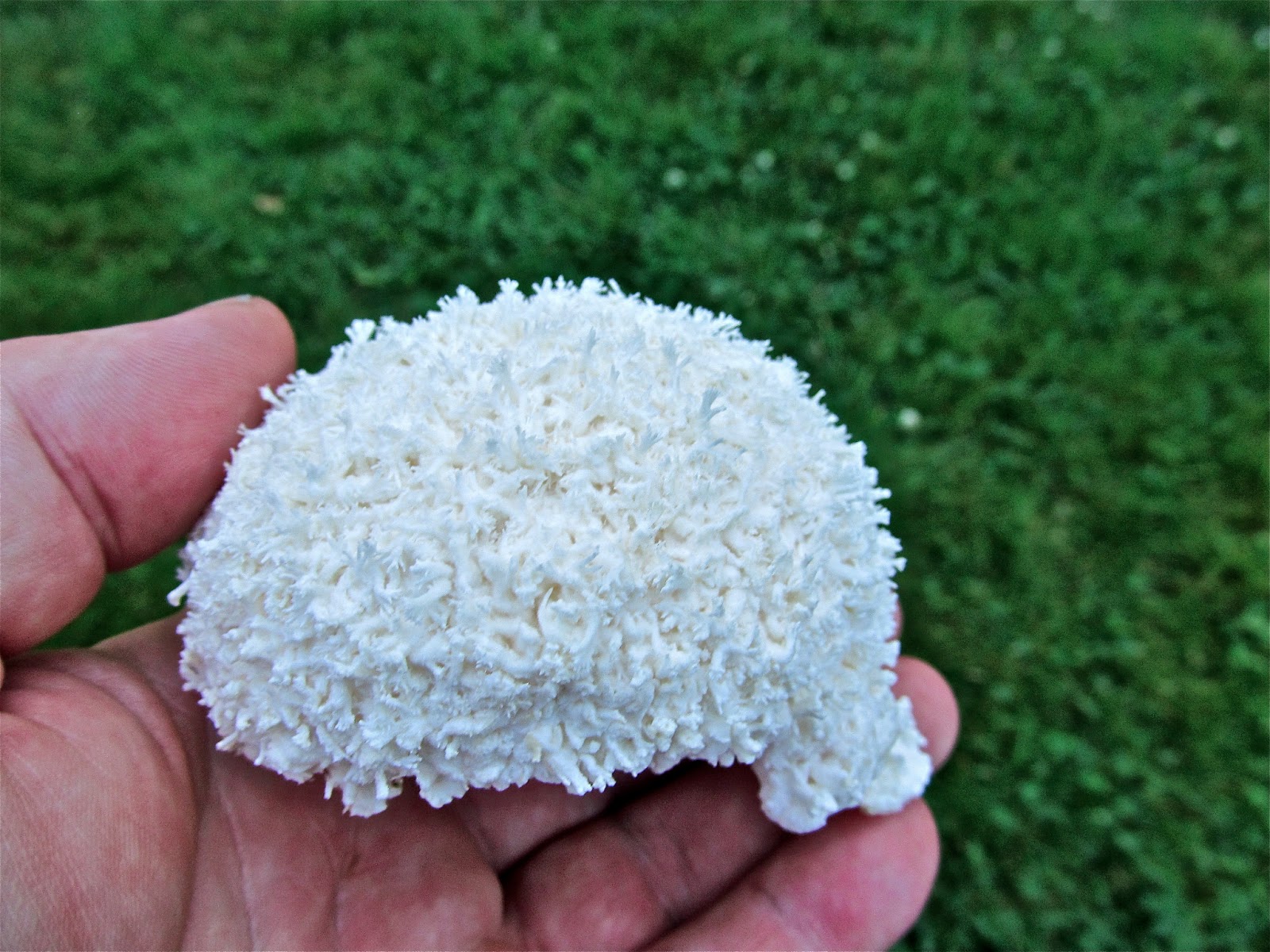
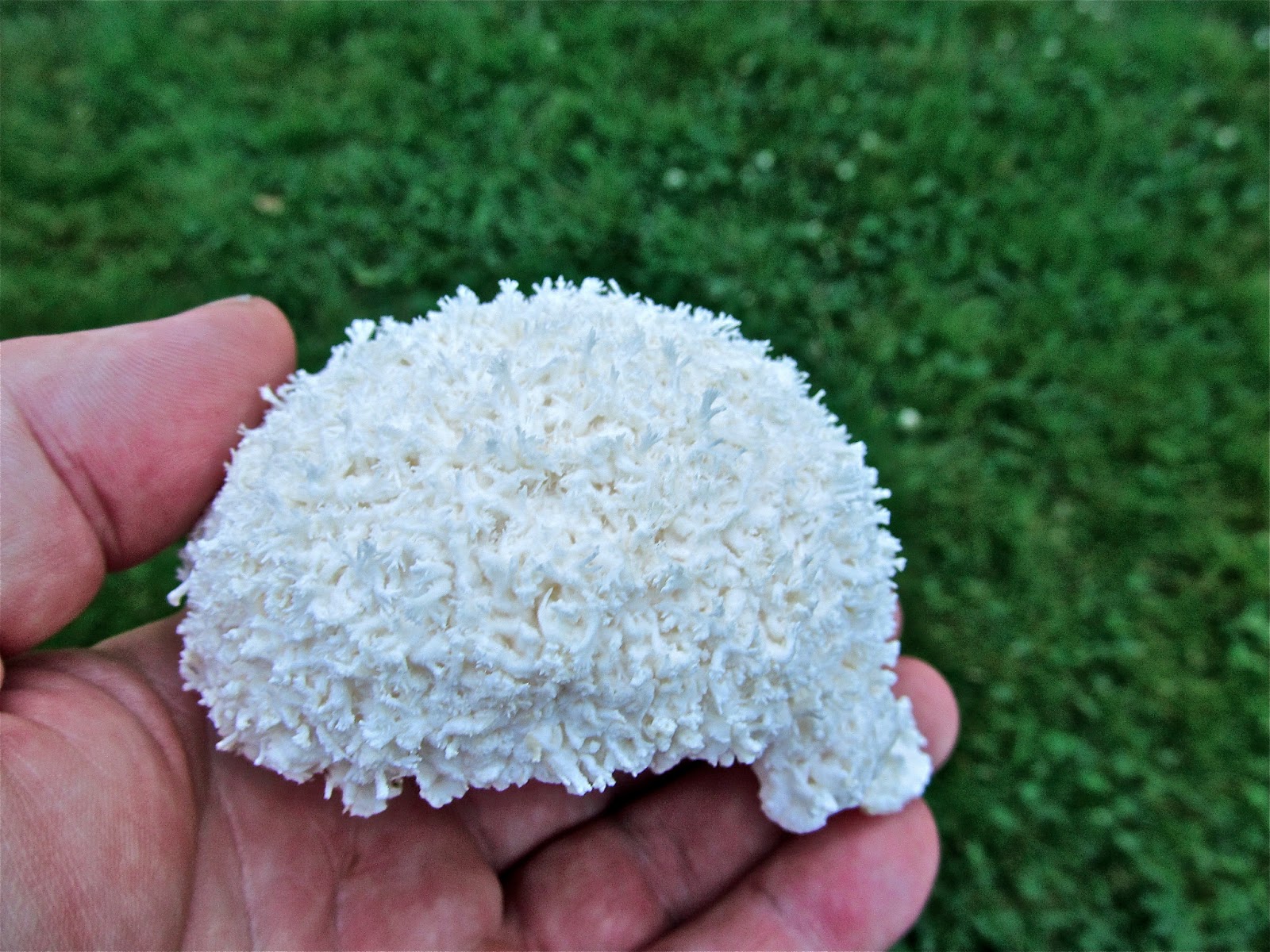
It goes fractal. More like sea-life than a lion's mane. There's still a core (the cut 'stem' at the center of this photo), but branches proliferate, more and thinner with each iteration.

After cutting them loose, I did what I do with most fung-food: sauteed with butter and garlic (or onion, shallots,...all alliums). Next time around, I'll try some other preparations. Those tendrils in broth would work like egg-drops in soup, weaving well with sprouts and delicate vegetables.

The center, or the whole mushroom if you follow instructions and pick it small, is meaty. To me, there was a chewiness beyond what portobello achieves, and I'd like to try using these for burgers. Slices in the sautee ended up more or less like meat. I'd use this in stir-fry in place of chicken--the texture was better than tofu or other mushrooms in that respect.

Sunday, June 23, 2013

Accidental Yum.

Somehow yesterday, I moved slowly at everything and allowed myself to become distracted so many times that it was nearly 10:00 before I got to cooking dinner. There were some potatoes sprouting eyes and begging to be eaten, a few hundred cc's of beans, and not a lot else. But at that point, culinary creativity and gustatory inspiration were far less important than filling my gut, and I set to cooking.

The beans only needed heating, so the first thing I did was dice the potatoes and throw them in a hot skillet with some oil. Every few minutes, some spatula action and maybe a toss or two to avoid the raw-on-one-side crispy-on-the-other syndrome. In between spatulations, I'd scatter some salt, grind some pepper, shake on some powdered garlic, or dump in some taco seasoning from Buck's (one of the few plug-links you'll ever find here--they are so good I suspend my fatwah against commerce here on the blog), an Olympia treasure. For some reason, I decided that a dash or two of cinnamon would be a good idea.

Even with the creative outlet of adding another spice at each turn, shallow-frying potatoes takes a while. During that while I decided that the increasing difficulty of scraping softened starch and a growing amount of spice-skudge, not to mention the desire to get the still crunch-raw tater-centers to cook, dictated a switch to braising. So I readied a couple cups of chicken broth, and let the potatoes sit and fry until on the brink of burning, then deglazed with the liquid.

As this came to a boil, I dolloped in some sour cream, and dropped in a handful of homegrown tarragon. As the sauce reduced, a couple of samples told me that this time, my near random addition of ingredients had worked. By the time it was thick, the potatoes were done.

I'd write a recipe, but none of the amounts were measured, and I've described the process. Now that it's posted, there's a fair chance that I won't forget this discovery, which is enough for me. If any of you try it, I'd be interested to hear how you like it.


Monday, June 3, 2013

Morels Now and Later

Fruit o the Morel

The "naturals" come before the wild-fire borne morels, so says the picker, and I have no reason to doubt them his expertise, although I did walk away shaking my head as he continued to rant about Obama and what "they say" are his impeachable offenses.

The guy's politics are not enough to make me pass on the fresh mushrooms in a bin propped up under the shade of his pickup canopy. (If it were a Dodge, I'd pass, but it's a Ford, so OK.) Also, his price is 33% below that in the stores and farmers market, and they're clean, firm, not too old or bug-eaten at all.

Shallot Scapes

Not irrelevant to this decision is the fact that I felt the need to go harvest shallot scapes and make use of them before they got too big and tough. And so it was that a few hours later, an age-old skillet that got my dad through grad school many long years ago got a taste of allium-mushroom-butter. Attacked by a bout of forethought, I decided to slice up the bigger (less likely to quickly dry) morels first. Here is what that kind of fresh looks like:


But the kind of deal I got feels too good to fritter away on a few ounces of fungal goodness, and I purchased a pound. Which in turn is too much to fritter away on a meal eaten alone. With all the big scapes cut, I could've tossed the shrooms in a paper bag in the fridge and reapeated this gistatory goodness in a few days, but the cheapskate in me has touble eating that high on the hog twice in a week. So the tuna can came out of the cupboard and the remaining morels went into the oven to dry out.


You may have guessed by now that I am not the kind of guy to have a food dehydrator, and the day in question was cloudy with intermittent rain, so sun-drying was not an option. So into the wee convection oven they went. Various web pages dedicated to mushroom-drying advise against exceeding 175 degrees fahrenheit, lest the psychoactive chemicals degrade, and even thought I am in a different genus, interested only in food, I figured 150 was good. The fan keeps the air circulating, and a fork propped in the door lets moisture escape. This particular oven shuts off after 30 minutes, and I just kept rpeating the process until the mushrooms were hard little nuggets, like this:


Drying morels this way realeases and maybe bakes the spores, causing this nice pattern to appear on the pan. The cooled morels went into a mason jar for later use. They smelled intense, no hint of burn, and it seems like my ad hoc dryer worked just fine.

Thursday, May 23, 2013

Metric Beans

Do this once.

Beans are simple, and so is the metric system. Put them together, and eat simply, cheaply, low on the food chain and carbon emission spectrum.

I've written about it before, but that was a while ago, and for new readers, here's the logic: cook a big mess o' beans in the crockpot, and you've invested minimal effort in return for several meals' worth of protein.  

Do this twice.

In case the photos are not obvious enough, here's the recipe:

1000 cc beans (cc= cubic centimeters, because volume's the quickest measure to make)
2000 cc water
Put all this in a crockpot with a metric toss o salt. Turn it on. Wait til the beans are soft before you eat them. 

That's it. 

Saturday, March 30, 2013

Northwestest Salt


A few weeks ago, I worked at Point Roberts, which is a landform (not a 5-4 decision written by the SCOTUS Chief) that is part of the Canadian mainland, but part of the US. It's the western end of Boundary Bay, and because it noses south of the 49th Parallel, is part of the Lower 48, if not the contiguous United States. It is the northwesternmost part of the US outside of Alaska, and therefore I resolved to make some salt from this place. 

Because I was camping, and because making a couple of international border crossings with a bag of white powder seemed like not such a good plan, what I brought back to Olympia were a couple of growlers filled with sea water. [Growlers being jugs--half a gallon in this case--that we Cascadians keep handy to fill with beer at the brewpubs spaced and conveniuent half-mile intervals throughout our land.] Customs and Border Patrol are unconcerned with this, although in the line-up I was wondering if I'd have to explain why I was transporting seawater.

Making the salt is pretty straightforward, as I've figured out before. It looks something like this:


This time around, I learned a couple of things. One is that you can burn salt. Set it to boiling, and get sidetracked by a phone call, and you end up with this:

Add caption

The grey crust at the bottom bothered me, so I scraped off the good part, added water, and filtered it before starting over, paying more attention to the boil this time. Eventually, enough water boils off to leave a bubbling white paste, which with some stirring can be relieved of most of its water.

But not all. The penultimate phase is paste. This goes onto a stone tile that I use for baking and pizza:

My favorite salt shot yet.
 I've kept salt (from South Carolina, in that case) at this paste stage before, and it' s actually a nice texture to work with. Fine grained but cohesive, easily dissolved into water or sauce. What makes salt at the penultimate drying phase best and most unique is that it is spreadable. Excellently easy for salt-crusting a piece of chicken.

But for whatever reason, I wanted this northwesternest US salt to be totally dry. So I spread it on the stone and cut furrows through it to maximuze surface area and make the drying quicker and more thorough. Popped it in the oven on the lowest setting, and when it felt dry left it in with the door open. It didn't take much. I'm pretty sure if I'd brought it across the border looking like this, I would have been arrested:

So, that's the story of making salt from the Salish Sea west of Boundary Bay. It's good,...salty. It came with less grit and arthropods than some of the salt I've made. Maybe not a fancy gourmet salt, no color or extra flavor, just the good clean merroir of the northwestest salt I could reach.

Monday, March 25, 2013

Bottom of the Barrel


Most of us buy our food, and have little or no connection to times of plenty and famine, cycles of harvest and lean times. Often as not, modern people asked to name the hungriest time of year will name Winter. But before global transport of food from wherever the harvest is coming in to suburban USA, before food preservation technology took hold (nostalgia for canning gets us, oh, a fraction of a percent back toward the dawn of the human appetite), Spring's beauty was draped over the harsh reality that the livestock were yet lean and the crops were mere aspirations, months from fruition.

Stocking a larder and avoiding losses from it, therefore, was a matter not just of avoiding guilt over waste, it was crucial. I've availed myself of canning, a bit of freezing (I may have bouts of nostalgia, and experiment with ancient foodways, but hey, I'm not gonna forego modern conveniences entirely), and have transformed part of my garage into a cellar with hanging mesh sacks of shallots and onions hanging, potatoes stashed in dark places, and crates of apples. Recently, the Winter Solstice a fading memory and sunlight growing every day, the apple scent experienced a slight change, the sweet lilt got a tangy edge, mellowing turning into fermentation and, if I did not move, outright rot.

Sure enough, the last milk crate of apples purchased just before the Farmers Market shut down for the Winter had a few bad ones. Many of the remainder had bad spots, and passive preservation clearly could not continue without spoilage loss. 

 
So I did what any reasonable person would do. Handed my eight-year-old a knife and told her it was time to learn how to cut. She's had some practice with avocados, but even an old apple is harder than that, and we worked together, me teaching her how to hold the knife and the food, pointing out when she was about to risk slicing herself instead of the fruit, and how to avoid that. Adding blood to the applesauce is no way to get your iron.

We had a great time, and in the end we had a bunch of applesauce, which can be put in the fridge, the freezer, or even canned so that the apples season of 2012 can last past the lean months. The compost got a meal of scraps, and we got enough delicious sauce for a bunch more meals.


Tuesday, March 12, 2013

Carb Dogs


Back off!
Recently, scientists published the results of a study on the canine genome. One of the crucial differences between dogs and wolves, it turns out, is that only the dogs can digest carbs. For a very long time, scientists and common sensists have reasoned that the domesticated dog as originally a wolf that followed humans around and fed on their middens or kill sites. A few people, sly as foxes, reasoned that both humans and wolves congregated around kills and carrion, and that the domestication process may have been more commensal than unidirectional. 

But now the genes tell us that the domestic dog can consume carbohydrates to some benefit, whereas los lobos cannot, and we move from an understanding of mutual carnivorism or scavenging to four-leggeds hanging around two-legged gatherers or farmers. [Eventually, I have no doubt, I wil learn of the legend in which farming is just a trick that coyote plays on humans so he can eat for free.] Whether it was people growing grain or digging roots, odds are that this imputes a greater role to women than the meat-eater model would have suggested, since women have long dug the wild roots and tended the gardens while men went off to hunt, or whatever it is they did when game was scarce and beer was not yet been invented.

The dog-carb connection comes as no surprise to me. I have a dog that is healthy, and a huge fan of bread. Serendipitously (or, honed by evolutionarily), the mutt likes her bread stale and hard. She is a huge fan of old bagels, and the photo above is her eating a burnt and aged loaf of soda bread, inedible to humans. In that shot, she is slightly blurred because she senses a threat and is springing into action, she feels like the photographer is coming after her precious lithified loaf. Never have I seen a dog of my acquaintance so viciously protective of something not made of ham. 

So thank you, scientists, for vindicating my non-obese, non-diabetic hound.

Sunday, February 3, 2013

Preserving Garlic*

Garlic Unclad

If you tuned into the Garlic Calendar, then you know that the cloves sense the Winter Solstice, and commence to sprouting, threatening your year's supply of homegrown flavor. But I'm such a procrastinator that I cannot follow my own advice, and it was only in the new year that I got around to peeling and storing the dozens of cloves that were sitting in the garage. Just these couple of weeks had the garlic doing this:


Hot erotic garlic, or just reproduction?

While they're starting on the new cycle that would birth a new plant, the cloves are not yet too far gone (besides, I kinda like the look of slices with the green circle in the center). But before the sprouts get as long as the cloves from which they spring, before the flesh gets soft, before pungent aroma becomes putrid regret, I need to somehow stop the process. In years past, this has been a matter of dropping peeled cloves into a jar and drowning them in olive oil. I did that again, but this time I'm trying a couple of other methods.

Salt and the earth.
Here's experiment #1. Good old fashioned salting. Pour pickling salt into a jar, put in a layer of peeled cloves, then bury them in salt, then more garlic, more salt,...you get the picture. The cloves are firm, and I did not irrigate, so I don't expect osmosis to create a saline slush, but it's an experiment. For reference, the majority of the cloves in the first photo and a bunch of salt filled a pint jar. I'll check back in later to let you know if this is a fail, but I suspect that what will happen is that the cloves stay intact, and I get a batch of garlic salt.

Experiment #2 is yet to be done. I had a bunch of large-cloved heads of garlic this year; some are elephant garlic, but not necessarily all. The plan is to roast them, smoosh the result, spread it out on parchment paper, and dehydrate it. I'm aiming for something like fruit leather, a hide of garlicky goodness that I can snip into strips or drop into the pot whole whenever I want that twice-roasted garlic flava.

Winter Morning Sun Dawns on Evening's Leavings

And then there's this, the old standby: cloves in oil. Chopped or pureed garlic tastes harsh and goes bad quicker. Drowning while cloves in oil and keeping them out of direct sunlight seems to halt the sprouting process. I'll remove the rubber gasket from the jar above so that the occasional fermentation fart can escape. In time, the cloves will soak up the oil and become beautifully translucent, edible amber. 

There are other ways to preserve garlic, but I don't like them (pickling? I just throw some in the cuke pickles I make, and that's plenty for my taste), or I don't know them. If you want to write in with others, I'll listen.

So if you have not yet dealt with your garlic, do it now! 

* [For whatever reason, it took me a month to think of my Greenstead post as food-ish, and post it here.]

Saturday, December 29, 2012

7 7 7 Marmalade


Last Winter, I made marmalade and wrote about it. The marmalade was great, the recipe acceptable, and the writing kinda bad. 

Last week, I made another batch, because Cara Cara oranges were on sale for 88 cents a pound. A lucky double-eight smiles on fate in many cultures, so I took it as a sign that I should fill a couple bags and get to cooking. Even without mystical callings to make jam, cheapskates like me know that 88 cents is about half the usual sale price, and that it's a good bet the citrus is dead ripe and they're in a hurry to move it. Deal lapse and fruit rots, but every once in a whole fate smiles and if you're alert you can capture it in jars, preserving it til you need it.

With enough for a couple of batches, I had opportunity to improve on last year's operation. So here I am again, reporting, but this time not burdened with writerly pretensions.

It's called 7 7 7 Marmalade because there are 7 pounds of oranges, 7 cups of sugar, and it makes 7 pints. The amount of water isn't 7, but I'm gonna ignore that. Here's the recipe.

7 7 7 Marmalade

Get 7 pounds of oranges, (Cara Cara is what I use, but the main thing is to get something with an aromatic skin.)

Peel the zest from 3 oranges, and then halve and slice the whole batch. Make the first cut from naval to where the stem was, and the slices should be a half centimeter thick. (That's a skinny quarter inch, Americans.) Cut up the zest however you want. I go for a random chop that yields everything from slivers to uncut pinky-sized pieces (That's over 5 cm, everyone else in the world; in the US, "pinky" is your small finger, and is an acceptable unit of measure.) Put the zest aside.

If you're smart, lazy, or both, you'll be sliding the orange slices directly into a 12 quart stock pot, which will be about full when you finish.

Pour 4 cups of water into the pot and start cooking.

I start at the low end of Medium High on the stove, and once the boil begins, start to inch it up to high Medium High. (That's, uh, nobody really knows what temperature stove knob units correlate to. Sorry, citizens of earth.) Let some of the water evaporate, but the goal is not to boil off the liquid; go for a long low boil that dissolves the pulp and a lot of the pith. The end result will remain liquidy and most un-jamlike.

After the first boil.

Now, let it sit til the next day. It gives you a break, and I think it helps maximize the natural pectin. Yeah, that's right, don't add pectin to marmalade. It makes its own. 

When it's time, get your canning set-up in order, and be sure you're ready to stand at the stove and stir for a while. Put on "Blowout Comb" by Digable Planets, or some other hour-long album, and then put the pot back on a low Medium High stove. 

Add 7 cups of sugar and the zest and stir them in well. I also experimented by grating half a nutmeg into one batch at this point, and about an inch of ginger root into the other; not sure if I really taste it.  Watch and adjust the temp as necessary until you have a hearty simmer. No lid this time, because you do want to cook it down. At first, no need to stir constantly, but by about Track 7 (titled "Dial 7," see why this CD fits this recipe?), you should see the marmalade beginning to emerge. I've been using a large metal spatula for the stirring, because it's long handle keeps my hands away from the sugary lava, and it's good for scraping the bottom so nothing sticks. 

There are all sorts of recipes that say the jam must reach specific temperatures, or recommend tests like dropping some jam on a cold plate to see if it is thick enough. But the risk of burning yourself to get thermometer readings or the hassle of another dish to wash are not necessary. Here's how you know it's ready:
  • You see the jam getting darker, and that more of it is sticking to the side of the pot.
  • You hear the boil change from simmer to thick ploppy bubbles, and finally to a rumble bubble that explodes each time you stir.
  • You feel your arm muscles burning as you stir through thickening glop.
Cut the heat and get the jars ready. Make sure your canner water is boiling before you put anything in the jars. I usually start that at the same time as the marmalade boil, dialing down once it reaches its own boil, and then crank it up again along with a smaller pot of water to sterilize the lids when the marmalade is ready.

Leave a centimeter or a skinny half inch of headspace as you fill half or whole pint jars. (I put a spoonful of bourbon in the bottom of two pints, but will wait a while to sample those.) Screw on the lids loosely and process for, you guess it, 7 minutes. 

For those of you who cannot abide stream-of-consciousness recipe format, here's the listy version:

Ingredients
  • 7 pounds oranges, sliced thin after removing the zest of three oranges.
  • 4 cups water
  • 7 cups sugar

Directions
 
Boil 1: oranges and water until pulp dissolves and skins soften
Wait overnight
Boil 2: and sugar and zest to the mix and slowly return to a boil, stirring increasinly often
Use your sense and the done-ness list above to know when to stop.
Boil 3: process half or one-pint jars in boiling water canner for 7 minutes.  

Yields 7 pints.


Saturday, November 3, 2012

In the Pantry, 2012


Last Fall, I made a list of what I had canned. Some of it remains on the shelf, testament to the facts that I do not particularly like pepper relish and that there are limited uses for rose hip syrup. 

This year, I have these things:
18 quarts - tomato
17 quarts - dill pickles (4 from last year)
5 quarts - sweet pickles
4 quarts - sour (fermented) dills
1 quart - dill pickled beans
1 quart - dill pickled red cabbage
9 pints - pickled beets
7 pints - plum syrup (to be re-processed into jam)
4 pints - pepper relish
5 pints - blackberry jam
2 pints - strawberry jam
2 pints - marmelade
2 pints - smokes salmon
1 pint - serviceberry
1 pint - sauerkraut
1 pint - "hot jam" marmelade
1 pint - pineapple-mandarin marmelade
1 pint - pickled pimento
3 half-pints - rose hip syrup
2 half-pints - serviceberry
2 half-pints - cranberry sauce
1 half-pint - hot jam
1 half-pint - cranberry-blood orange marmelade 

In the freezer:
2.5 quarts - nettle
2 quarts - spot shrimp
2 gallons - hops

Sitting in boxes in the garage:
A few pounds of homegrown taters
A year's supply of homegrown garlic
A grocery bag of black moss
A smaller bag of homegrown tomatillos

On the herb shelf:
2 gallons - dried mint
1 quart - dried oregano
1 pint - dried thyme
1 half-pint - tarragon
1 half-pint - poppy seeds

This is not so different form last year, except that I obviously did not get to freeze a salmon, and I got a deal on beets. Also, I moved into fermentation, which reminds me that the list should include:
>1 sesqui-gallon of sauerkraut in the works, bubbling desultorily until it's time to jar it up. 

If I can get some Chinese cabbage at the farmers market, I may add kimchi to the list by year's end.

This year was no good for mushrooms, and I still didn't get a fishing license, so I don't see the larder getting any fuller. Circumstances did not allow a real garden this year, so mostly I canned stuff that other people grew. I am about as far from being self-sufficient as ever (which is to say, for garlic and oregano alone), but once again I can look forward to pickles and tomatoes fairly regularly without exhausting my stash. And probably kraut. 

Not sure in which way I will expand or experiment next year, but there's plenty of Winter yet to figure that out...

Thursday, October 18, 2012

Kosher or not, Smoked Meat for Breakfast


With the warm dry summer this year, Northwest gardeners (or the people who buy from our farmers) got to have delicious tomatoes. Short days, cold nights, and wet marine air have shut down further ripening, but the memories are delicious. 

One of my flavorite reminisces has to do with the aroma of toasty bagel mixing with smoked salmon. The dance of cool tomato and warm bread on my tongue, of smooth cream cheese and poppy seeds vying to please, makes my mouth feel happy. The religion I was raised with is confusing enough, so figuring out whether mixing fish and cheese is kosher is way beyond my expertise; the fact that all my Jewish friends are fine with lox and bagels does not really convince me, since most of them are all about as devout as my own pagan, shiftless, skeptical self. 

Back East, I'd have lox and bagels now and then, but even in the '80s, tomatoes available in delis had begun shedding their flavor, and the lox was a cold damp minislab not so different from the other cold cuts. Here, I've finally been exposed to real smoked salmon, and as luck would have it I received a few jars of primo smoked salmon at a couple of tribal give-aways this Spring. Alder-smoked wild salmon crumbled over local cream cheese is to what I used to get in delis as a Northwest IPA is to a can of Bud...I'll take the latter over an egg mcmuffin or a coors light, but it ain't the same thing.

Not so Kosher, the Joy of Goy.
And then there's the other thing. Pork. At the Olympia Farmers Market, now and then you can get bacon made from organic pasture-raised piggies. No parev work-around on this, it's just straight-out not kosher. Damned delicious, I guess that's how I would describe it. Mix it with a bagel and cream cheese, or eggs, whatever. Blow the thin blue tendril of skillet-smoke out the kitchen window as an offering to whatever gods you want to please.

Too much of these good things may not be good for your body, never mind your spiritual health. But to deny yourself these deliciousnesses on the basis of archaic laws is a bit too much sufferation for this heathen, and maybe of other people with taste buds. But if an ancient law forbids you from eating this way, I wish you well, and will help dispose of your share. 


Wednesday, October 17, 2012

Cider Days


This week, I'll squeeze another batch of cider. I inherited a big press on my way out to Washington, an 1870s monument to cast iron and oaken framery that saved my life by weighing down the pickup bed across miles of Wyoming ice. 

Apples started dropping early and dry this year, but there are still trees laden with fruit still sweetening as the weather cools off. A neighbor let me pick from his tree, and I have two boxes sitting in the garage ready to go. Earlier, the first apple tree I ever planted yielded enough fruit for a half gallon of cider, and I got some more from a neighbor's windfall.

I'm not what you'd call real particular about the quality of fruit, but the windfall stuff has enough worms and incipient rancidity that it needs some surgery before making cider. Blemishes and outright ugliness don't matter, and old timers will tell you that some bruises are a good thing when it comes to cider. 

I wash all these pomological freaks in a galvanized tub, and then it's time to call in the help. Kids are perfect. I get the crank turning til the flywheel is spinning along nicely, and the little one starts tossing in apples to be crunchewed between teethy drums that spit bits drunkenly into and all around the bucket below. Immediately the air turns sweet, but for some reason this fall we were not beset by yellowjackets or bees.


A bucketful of chomped apples is now ready for the pressing. The long and increasingly difficult  turning of a giant iron screw that presses the apples while they sit in a slatted bucket on a slatted table. Juice flows out the sides and the bottom, hitting the drainboard and flowing into a container as the littler daughter makes sure nothing is lost. The bigger one uses a big ironwood stick to gain leverage, squeezing every last drop from the thinning wheel of apples crushed inside the bucket. Meanwhile, I sit back and enjoy a break. 

Someday, I'll get serious enough about hunting down apples (pay for them? perish the thought!) and gathering gear to make a big batch and ferment it. Or maybe not. But I'll always treasure fall afternoons with the girls doing cider alchemy, turning the ugliest apples into nectar, using brute force to craft delicate tastes.